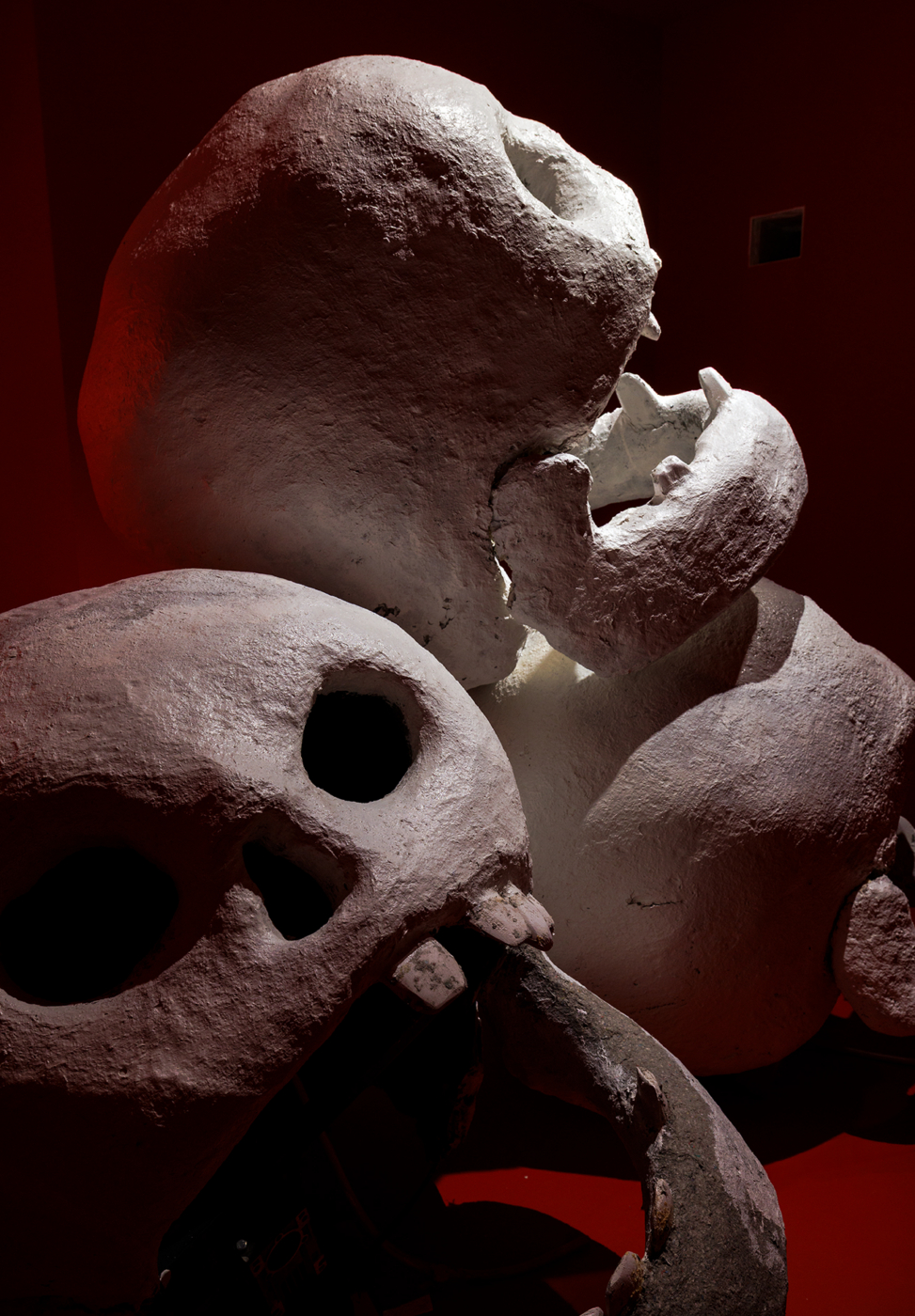
Why do people voluntarily seek out tension and fear? From watching horror movies on the couch to wandering through haunted houses or riding roller coasters at the fair: we love thrills and adrenaline, as long as it remains safe. This paradox is what fascinates artist Oscar Peters (1981). Humans are the only species that deliberately seeks out danger through films, games, and attractions. We want to feel the edge of our fear, without crossing it. With these ideas as a starting point, Peters conceived an artistic ‘haunted house’. His large-scale installation BARBARIAN at Monopole confronts visitors with their own fears and the desire to understand them.
Peters uses all the familiar ingredients of a classical haunted house – skulls, ghosts, a maze, and other archetypal tropes – to create a world where terror slowly makes way for questions about who we are and why we exist. In the end, the act of dwelling on such questions in a house with an exit that is difficult to find may well be the most terrifying thing of all.
Dancing skeletons
In Barbarian, you come face to face with dancing skeletons that shake their bones, gaping mouths that unexpectedly move downwards and a green maze of rotating walls. The installation falls somewhere between slapstick and terror: simultaneously comical and gruesome. Just like in classical haunted houses, humour and fear are constantly taking turns, a field of tension that keeps coming up throughout the installation.
A ticket to the end
Waiting at the end of the maze is a metres-high skull, built on top of a ticket machine. It is as if death itself is selling tickets. Visitors are offered a choice here: to buy a ticket to the end of existence or to once again be swallowed up by the maze. Positioned across from the skull is jester’s cap made from fabric, enticing visitors to step inside. While peering through the eye holes, visitors will once again be confronted with the towering skull on the other side. Through the eyes of the jester, they are thus literally looking death in the eye. For centuries, jesters have been holding up a mirror to us, making us laugh at things we would rather look away from.
Now, where exactly was that exit?
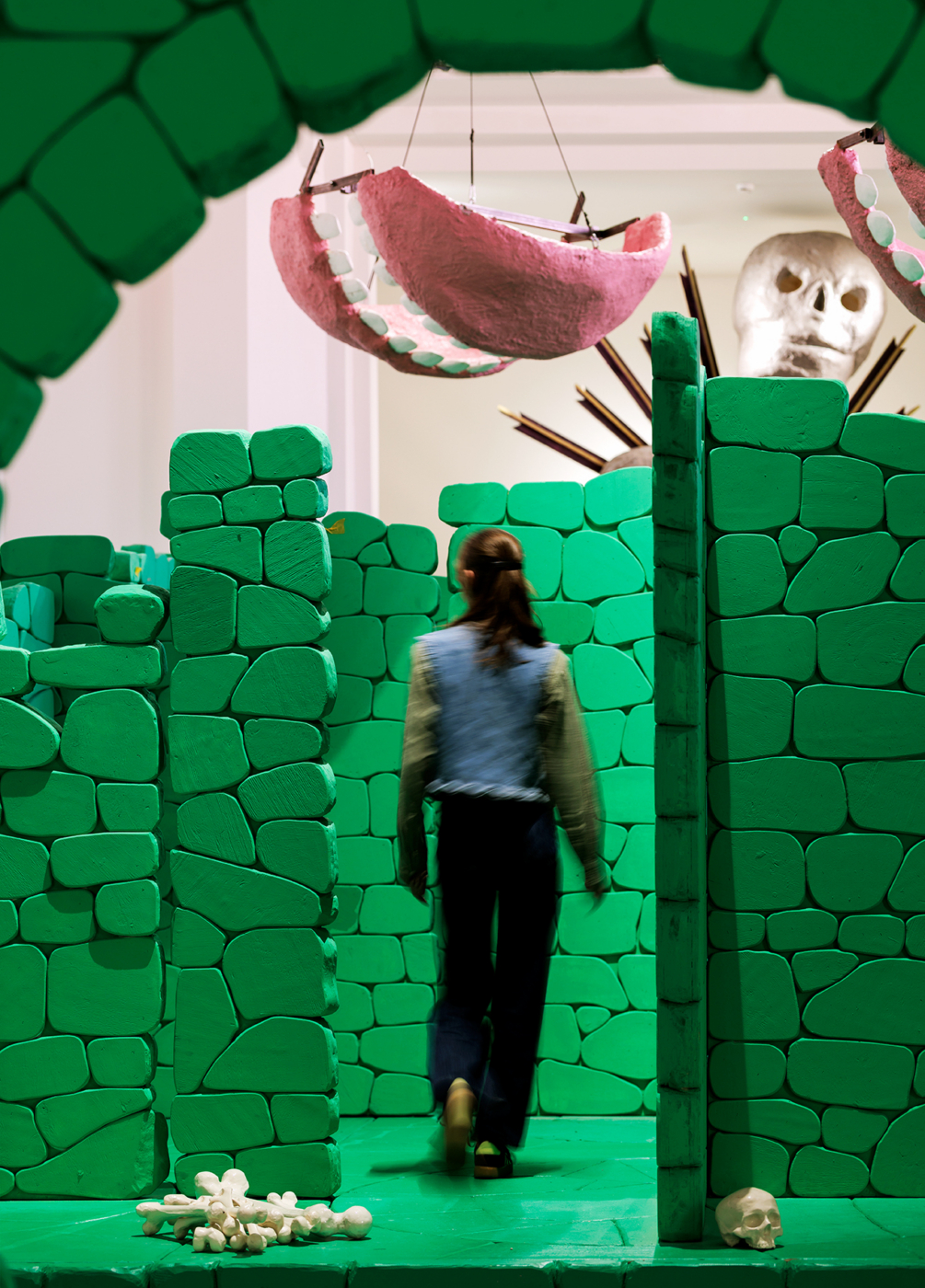
At the centre of BARBARIAN is a green maze made from imitation stone walls. These walls are slowly rotating, causing the structure to constantly change and making it seem as if the exit is disappearing even further out of sight. The installation constantly balances between pleasure and threat, humor and discomfort, nostalgia and escapism. At the same time, Peters deliberately reveals how the illusion is constructed: you see the wooden structures, brushstrokes, and theatrical effects. In doing so, BARBARIAN also becomes an ode to handmade spectacle in a time when more and more experiences are becoming digital.
Cabinet of curiosities
In a cabinet of curiosities, he also presents his own collection, which he has been building from an early age: from the pop-up book Haunted House by Jan Pieńkowski to the board game Spookslot. Peters draws inspiration from horror films, funfairs, comics, amusement parks, and fantasy worlds such as role-playing games and retro horror. With BARBARIAN, he explores why people continuously seek out controlled tension – that singular moment just before the drop.
Step into a world where you are free to get lost, be frightened, escape and perhaps discover something about yourself along the way.